
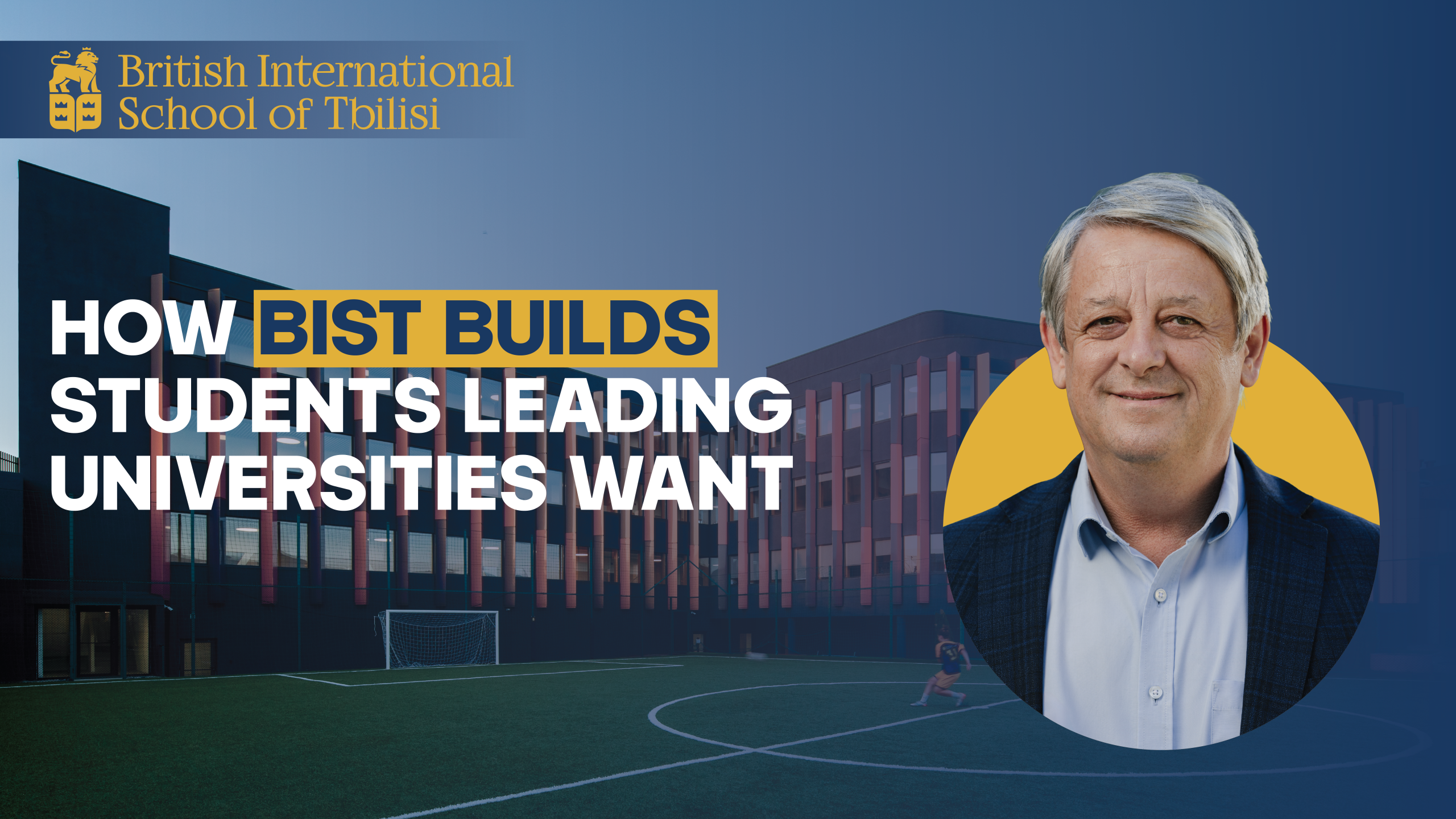
How British International School of Tbilisi Builds Students That Leading Universities Want
A conversation with Dr. Caradoc Peters, University & Careers Guidance Counsellor, British International School of Tbilisi
There is a moment Dr. Caradoc sees every year. A family arrives, their child is in Year 12, and they are ready to start thinking about university. They are not late. But they could have started sooner.
Dr. Peters is the University and Careers Guidance Counsellor at British International School of Tbilisi. He holds a PhD and university counselling qualifications from the British Council, Times Higher Education, Columbia University, and Rice University, and brings 27 years of experience to the role. His track record spans offers from Stanford, Columbia, UC Berkeley, UCL, LSE, Imperial College London, and Oxbridge. He attends international admissions conferences annually and maintains direct relationships with universities across the UK, US, and Europe. When admissions expectations shift, British International School of Tbilisi families are among the first to know.
Recent British International School of Tbilisi graduates have gone on to UCL – University College London, The King’s College London, the London School of Economics, the University of Edinburgh, the University of Michigan, Emory University, the University of Southern California, Bocconi University, and Delft University of Technology. These are not fortunate exceptions. They are the product of a process that begins long before Year 12.
Ambition Meets Fit: Choosing Among the World’s Best Universities
British International School of Tbilisi students are expected to apply to outstanding universities. That is the starting point. What the counselling process adds is precision: among those excellent institutions, which one gives this student the best conditions to perform at their highest level?
Among all the strong universities your students consider, how do you help them find the right one?
“Rankings are a useful tool. They tell you about research strength, employer reputation, graduate outcomes. But they don’t tell you whether a student will thrive in a particular environment. A future economist and a future doctor need completely different things. Our job is to help families think clearly across all of it, so that when a student receives an offer from a strong university, it is one where they will do their best work.”
— Dr. Caradoc Peters, University & Careers Guidance Counsellor, British International School of Tbilisi
This is not a conversation about moderating ambition. It is about directing it with precision. The goal is the strongest possible long-term outcome, which means the right outstanding university, chosen for the right reasons.
Strong Grades Are the Foundation, Not the Finish Line
At British International School of Tbilisi, students follow a rigorous Cambridge curriculum, with IGCSE and A-Level results benchmarked against international standards. The expectation is clear: students should be competitive at a global level, not simply strong within a local context. But Dr. Peters is direct about something that still surprises many families.
If a student is performing well academically, are they well-positioned for top universities?
“Grades matter enormously. But the benchmark is not the classroom, it is the world. Your child is being assessed against students from across the globe, all sitting the same qualifications. Being top of the class in Tbilisi is encouraging. It is not a guarantee of anything. Universities are not admitting grades. They are admitting a person. Your academic record tells them you can do the work. Your profile tells them who you are. A lot of students arrive at Year 12 with strong grades and a very thin profile.”
— Dr. Caradoc Peters, University & Careers Guidance Counsellor, British International School of Tbilisi
Profile means the full picture beyond the transcript: sustained commitments, depth of interest, and the coherence between what a student has done and what they want to study. A medicine applicant who has spent time in a clinical setting makes a very different case from one who has only excelled in biology lessons. The academic record opens the door. The profile is what walks through it.
What Leading Universities Are Actually Looking For
Admissions expectations vary significantly by country, and navigating those differences is a core part of Dr. Peters’ work.
How do you help students prepare for systems that want very different things?
“UK universities, especially the selective ones, want depth: subject competitions, work experience, evidence of intellectual engagement beyond the syllabus. In the US it is broader: leadership, community engagement, independent research, a student who has made a real contribution somewhere. European universities focus on academic profile and clear motivation. Australia and New Zealand value skills, work experience, and personal engagement. You need to understand the system you are applying to and prepare specifically for it.”
— Dr. Caradoc Peters, University & Careers Guidance Counsellor, British International School of Tbilisi
One distinction matters especially for UK and US applicants: the difference between extracurricular and supercurricular engagement. Extracurricular is what students do outside lessons. Supercurricular is what they do beyond the curriculum: independent reading, original research, intellectual inquiry driven by genuine curiosity rather than timetable. At the most selective universities, it is supercurricular depth that separates the applications that receive offers from those that do not.
Where the Application Comes to Life
British International School of Tbilisi has built an environment specifically designed to develop the qualities that leading universities look for and that examinations alone cannot measure.
Students prepare and deliver original talks through the licensed TEDx programme, pursue and present independent research at the Research Symposium, and design and build projects for the STEM Fair. Model UK Parliament develops the analytical rigour and formal communication skills that law, politics, economics, and social science programmes actively seek. Disney and Broadway licensed productions, staged to professional standards, give hundreds of students experience of working at scale under real pressure, developing creative collaboration and resilience in ways no classroom can replicate.
Across all of these, the outcome is the same: students who have done something real, who have committed over time, and who can speak with conviction about what they have learned. That is what makes a personal statement come alive.
Why do these programmes matter specifically for applications to competitive universities?
“Because universities want to understand who you are beyond your grades. They want evidence of sustained commitment and genuine curiosity. Anyone can list activities. What universities are really looking for is proof that something has actually shaped you. These programmes give students experiences they can speak about with conviction, not performances for an application, but things that have genuinely developed them.”
— Dr. Caradoc Peters, University & Careers Guidance Counsellor, British International School of Tbilisi
The Universities Come to of Tbilisi
Twice a year, British International School of Tbilisi hosts University Fairs bringing together representatives and admissions officers from approximately 40 institutions, including Russell Group universities and leading US and European schools. Students can speak directly with the people who will read their applications.
What do students gain from those conversations that they could not get elsewhere?
“Everything that matters. What a department is really like. What they genuinely look for in a candidate beyond the official criteria. What surprised previous students once they arrived. For students still working out their direction, sometimes one conversation changes everything. These institutions stop being abstract names on a ranking table and become real places with specific cultures and real people. That shift matters more than most families expect.”
— Dr. Caradoc Peters, University & Careers Guidance Counsellor, British International School of Tbilisi
For parents, the University Fairs offer something equally valuable: direct access, in a single day, to information that would otherwise require considerable time and travel to gather.
Guidance from Application to Arrival
When Year 12 begins and applications open, Dr. Peters and the counselling team work with every student and family through the full process: university selection, personal statements, recommendation letters, scholarship research, entrance examinations, and English language testing. They also manage the layer of logistics that families consistently underestimate.
What surprises families most when they get into the detail of applications?
“The lead times. Families focus on essays and grades, which is right. But there is a whole layer of administration underneath: documents that need certifying, tests that need booking months in advance, accommodation deadlines that arrive before offer deadlines. We flag all of it early, because missing something administrative is a terrible reason to lose a place at a university a student has worked years to reach.”
— Dr. Caradoc Peters, University & Careers Guidance Counsellor, British International School of Tbilisi
It Starts Now
The students who gain places at the world’s leading universities share one characteristic. They started preparing earlier than their peers, with better guidance, and a clearer sense of who they are and where they are going.
At British International School of Tbilisi, that preparation begins in the early years of secondary school. The academic foundation is built rigorously and benchmarked internationally. The profile is assembled over time through experiences that are genuinely formative. And the guidance, from a counsellor with the credentials and relationships to know exactly what is required, is present at every stage.
By the time a British International School of Tbilisi student sits down to write their application, the work is largely done. The question is not whether they are ready. It is which outstanding university they are right for.
British International School of Tbilisi | www.bist.ge